
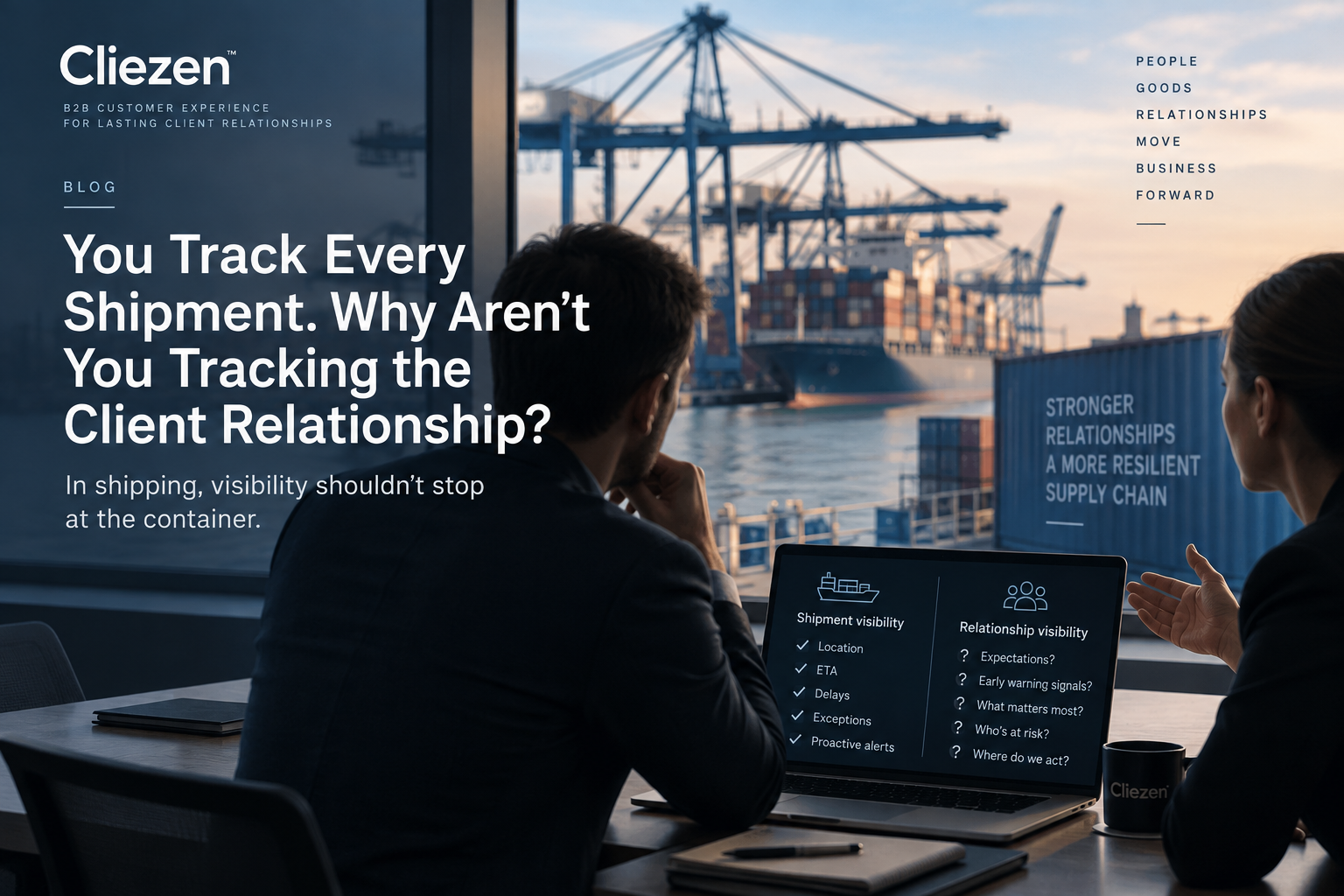
You Track Every Shipment. Why Aren’t You Tracking the Client Relationship?
You Track Every Shipment. Why Aren’t You Tracking the Client Relationship?
You wouldn’t manage a shipping operation by asking where the cargo was six months ago.
But that is surprisingly close to how many shipping, freight and logistics companies still manage client relationships.
Cargo has tracking. Exceptions have alerts. Delays trigger workflows. ETAs change as new information arrives.
Then we get to the commercial relationship and the methodology often becomes: send an NPS survey once or twice a year, run an account review, and rely on whatever the account manager happens to hear.
There is something backwards about that.
Shipping learned the value of visibility a long time ago
Modern logistics runs on visibility. Teams want to know where something is, what has changed, what is at risk and where intervention is needed.
The same logic should apply to client relationships.
A valuable account rarely disappears because somebody suddenly wakes up unhappy. More often, expectations and experience slowly drift apart.
Communication feels less proactive. Issue resolution takes longer than the client thinks it should. Reporting becomes less useful. Handoffs create friction. A competitor starts to look slightly easier to work with.
None of those signals necessarily trigger a complaint. That is exactly why they are dangerous.
The real risk is the expectation-experience gap
Traditional CX metrics tend to ask how satisfied the client is or whether they would recommend the supplier.
Those questions can provide a broad signal. They do not show where the relationship is drifting away from what the client now expects.
A client can still describe the relationship as “good” while believing responsiveness should be faster, reporting should be clearer or issue resolution should require less effort.
The important signal is not simply satisfaction. It is the gap between what the client expects and what they are actually experiencing.
That is why Cliezen focuses on expectation-versus-experience gaps rather than relying on a single loyalty score.
If you are still using NPS as the main relationship measure, see our B2B NPS alternative page for a more diagnostic approach.
Relationship exceptions deserve the same attention as operational exceptions
Shipping teams do not treat every shipment as equally urgent. They surface exceptions.
Client relationships should work the same way.
- An operations contact suddenly rates coordination lower than before.
- A procurement stakeholder says reporting no longer gives enough visibility.
- An executive sponsor stops engaging.
- Responsiveness drops below the client’s expectation on an account where speed matters a lot.
Those are relationship exceptions.
They should trigger attention before the account enters a renewal conversation, tender process or competitive review.
One score hides too much in a multi-stakeholder account
Shipping and logistics relationships are rarely managed by one person on the client side.
Procurement may care about cost and reliability. Operations may care about responsiveness, visibility and issue resolution. Leadership may care about strategic value, risk and predictability.
A single account-level score can easily hide disagreement between those groups.
That is why useful B2B feedback needs to stay connected to the individual stakeholder, their role and what matters most to them.
Our B2B client surveys guide explains how to structure feedback around multiple stakeholders rather than treating one respondent as the voice of the account.
Visibility without action is just reporting
Knowing that a relationship is drifting is useful. Acting on it is where the value appears.
A practical relationship-visibility model looks like this:
- Capture what matters. Understand which aspects of the relationship each stakeholder values most.
- Measure recent experience. Gather short, relevant feedback instead of running a long annual survey.
- Detect the gap. Identify where experience is falling below expectation.
- Prioritise by importance. A small gap on something critical can matter more than a large gap on something the client barely values.
- Trigger action. Assign ownership before the issue becomes commercial.
- Measure again. Check whether the experience improves.
This is the same operating logic shipping companies already use elsewhere: detect deviation, prioritise risk, intervene, and keep monitoring.
For more on turning feedback into action, see our client feedback management guide.
Operational visibility is improving. Relationship visibility should catch up.
Industry research increasingly shows how central visibility has become in logistics.
Recent studies have found that shippers place very high importance on technology and real-time visibility when choosing logistics partners. At the same time, visibility research continues to show a gap between what providers believe they are delivering and what customers feel they receive.
That mismatch is the point.
The supplier can believe the experience is working while the client is judging the relationship against a different standard.
Shipping businesses have spent years reducing uncertainty around cargo movement. The commercial relationship deserves the same discipline.
Track relationship movement as closely as cargo movement
Every important B2B relationship has expectations, an intended destination, deviations along the way and warning signals before failure.
Small exceptions become expensive when nobody notices them.
Shipping companies already understand that operationally.
The next step is applying the same thinking to client relationships.
Cargo gets real-time visibility. Relationships should not get quarterly guesswork.
For a broader look at relationship measurement beyond NPS, read the most effective B2B alternatives to NPS.
External reading: FedEx logistics insights and project44 visibility resources.
