How to Analyze B2B Client Feedback Across People and Time
A change in B2B client feedback is a prompt for a conversation, not a churn prediction.
To understand the context you need to analyze the feedback, compare what each customer stakeholder expected with what they experienced over time. Check who was asked, who replied, and whether the same people and questions are represented. Then ask the account owner to investigate the change with the customer.
At Cliezen, our team sometimes reviews lists of a supplier's former customers with that supplier. In those retrospective reviews, we often see accounts where experience scores fell as the relationship stopped meeting customer expectations. Some also showed less response to feedback requests or slower replies to wider outreach. Those are observations from reviews of known churned accounts. They do not establish a reliable warning threshold or prove why any current customer is quiet.
Which feedback can fairly be compared?
Start with a named customer account and a consistent topic: the supplier's employees and the product or service. Compare the same contact's response over time where possible. If a new person has taken over the role, note that change instead of treating the new score as a clean continuation of the old one. A financial decision maker and a daily user may judge different parts of the relationship.
Look at the base behind the pattern. Were the same contacts invited? Did some stop answering? Was there a service change or a different question? A falling average based on two responses may be more useful as a prompt to call those two people than as a chart for an executive meeting. The B2B survey guide explains why the account can contain several stakeholder perspectives rather than one uniform score.
What makes a change worth investigating?
Repeated negative feedback on the same important aspect, a widening difference between expected and experienced service, or several stakeholders describing the same problem all deserve attention. So does a change in one influential contact's account of the relationship. None is a diagnosis by itself. Check what else changed and ask the customer what sits behind the signal.
Pay attention to engagement as context. A customer contact who usually replies promptly but now leaves several requests unanswered may be busy, have changed jobs, be receiving irrelevant forms, or be unhappy with the supplier. Speaking with a competitor is another possibility, not a conclusion the data can support. The right response is to pick up the phone while there is still room for a candid conversation.
What can Cliezen surface that a manual review may miss?
Cliezen automates the sending, collection, and analysis of relationship feedback, preserving the history of the supplier's customer accounts. Its RQS approach organizes feedback around People, Product, and Process; CX Compass connects stakeholder priorities with reported experience; and Deep Dive seeks context behind consequential negative feedback. AI and machine-learning analysis can flag changes in replies and possible patterns across time and contacts for people to inspect. This is particularly useful when a supplier has more accounts and respondents than an account owner can reliably compare by hand.
The software cannot establish why a customer changed its view, whether a competitor is involved, or whether a promised improvement has worked. Our team also revisits earlier experience gaps in the supplier's feedback history to see whether the customer has confirmed improvement. Additional ways to strengthen that loop are still being developed, so they should not be described as current automatic outcomes. The client-feedback management overview provides more background on the collection-to-action workflow.
What should the supplier do when a pattern appears?
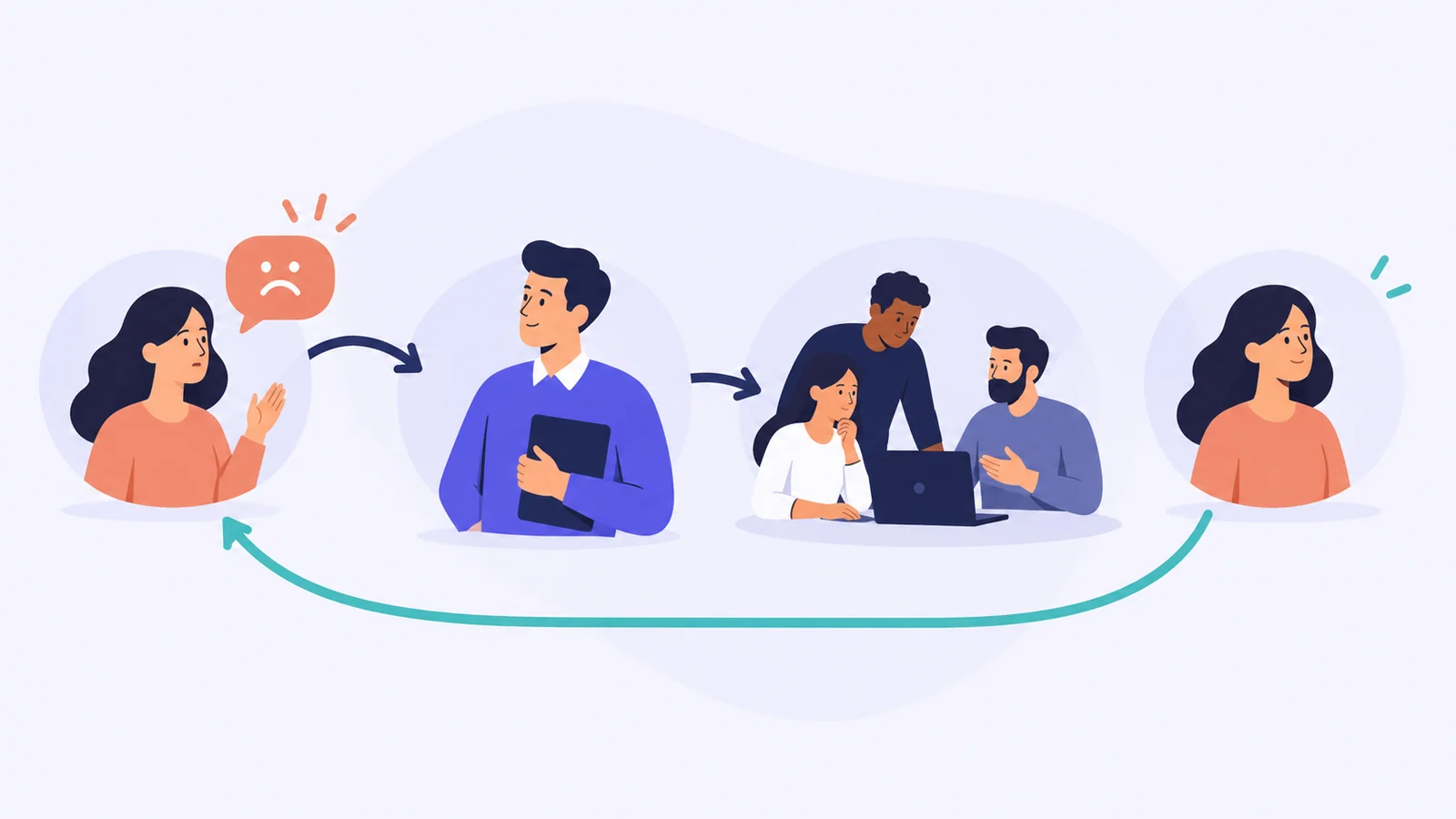
Give the account owner a short, specific brief: which customer contact or role, what changed, when, the previous expectation, and what remains uncertain. Call the relevant contact. A useful opening is: “We noticed your feedback about the service has changed. What is different from your perspective?” Listen before offering a fix or interpreting silence as rejection.
Following through on what the customer says
Record what the customer says separately from any software interpretation. Agree an action, owner, and return date where needed. Then check the same issue again with the affected contact. A response to a survey matters more when the person sees that someone read it and acted on it. The after-sales guide discusses connecting expectations at sale with the experience after delivery begins.
A practical first analysis
Choose one account with a changed response. Put its stakeholder roles, comparable feedback points, missing responses, and known service changes on a single page. If the explanation is still uncertain, that is the reason to talk with the customer. The objective is a better decision by the supplier's people, not a more confident label for an incomplete data set.
Kári Thor is the founder of Cliezen. He holds an MSc degree in Advanced Marketing Management and has 25 years of B2B experience, from tech startups to international companies, in roles spanning marketing, sales and customer experience. At Cliezen, he focuses on helping companies measure, understand and strengthen their customer relationships. Connect with Kári on LinkedIn.



.png)