
How NPS Can Actually Limit Growth for B2B Companies
How NPS Can Actually Limit Growth for B2B Companies
For more than two decades, Net Promoter Score (NPS) has been one of the most widely used customer experience metrics in business. Its simplicity helped it spread rapidly across industries. Ask customers how likely they are to recommend your company, calculate a score, and track it over time.
The problem is that simplicity often comes at a cost.
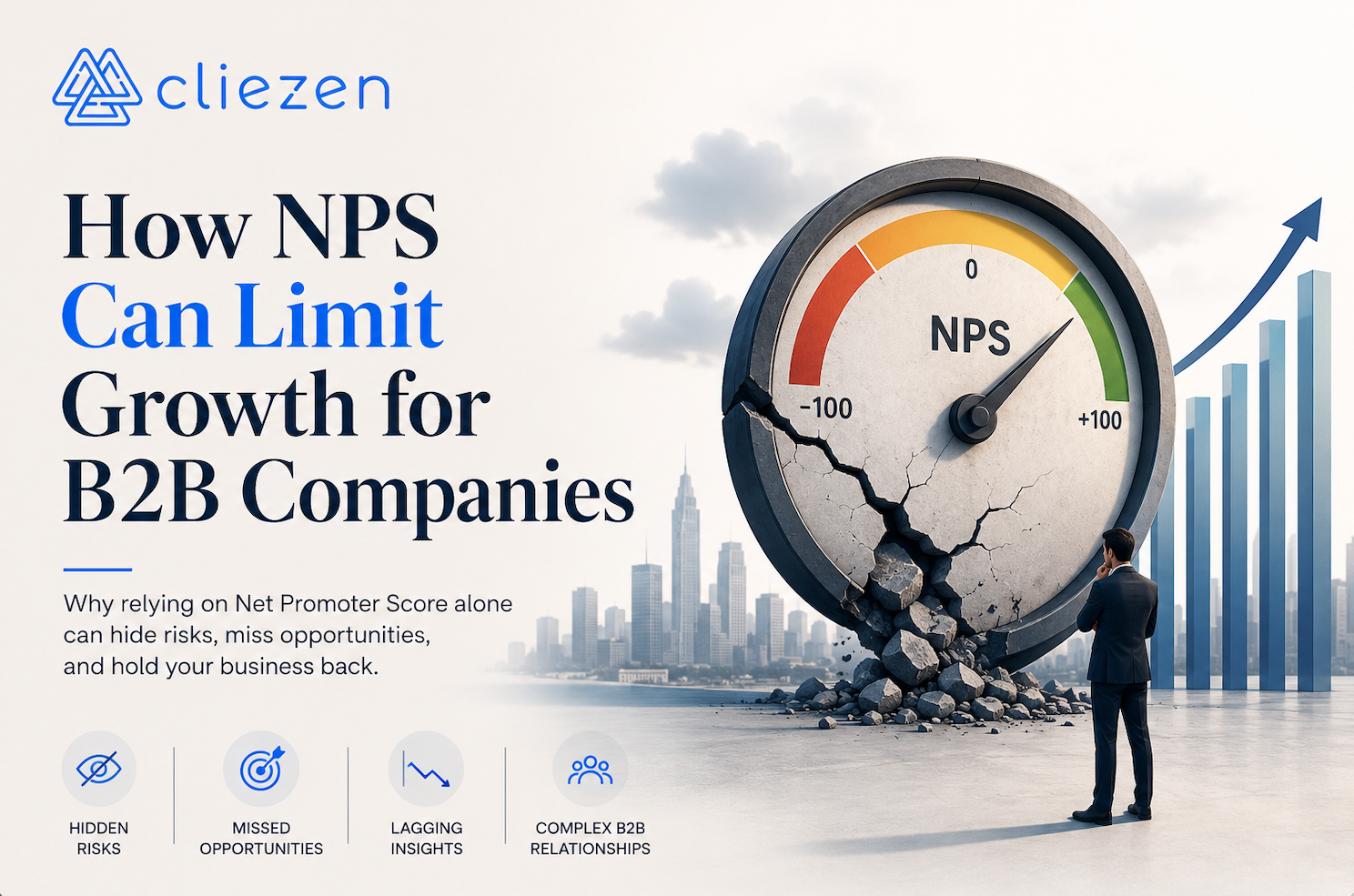
While NPS can provide a high-level indication of customer sentiment, many B2B companies discover that it offers very little guidance on how to improve customer relationships, prevent churn, or identify growth opportunities. In complex B2B environments where relationships are built over years rather than transactions, relying heavily on NPS can actually restrict growth rather than accelerate it.
The Problem with Reducing Complex Relationships to a Single Number
B2B relationships are rarely simple.
A contact may love your account manager but struggle with onboarding. They may value your product but feel unsupported during implementation. They may have concerns about pricing, communication, service delivery, or strategic alignment.
NPS attempts to summarize all of these factors into a single answer to a single question. A simple approach to a complex business relationship.
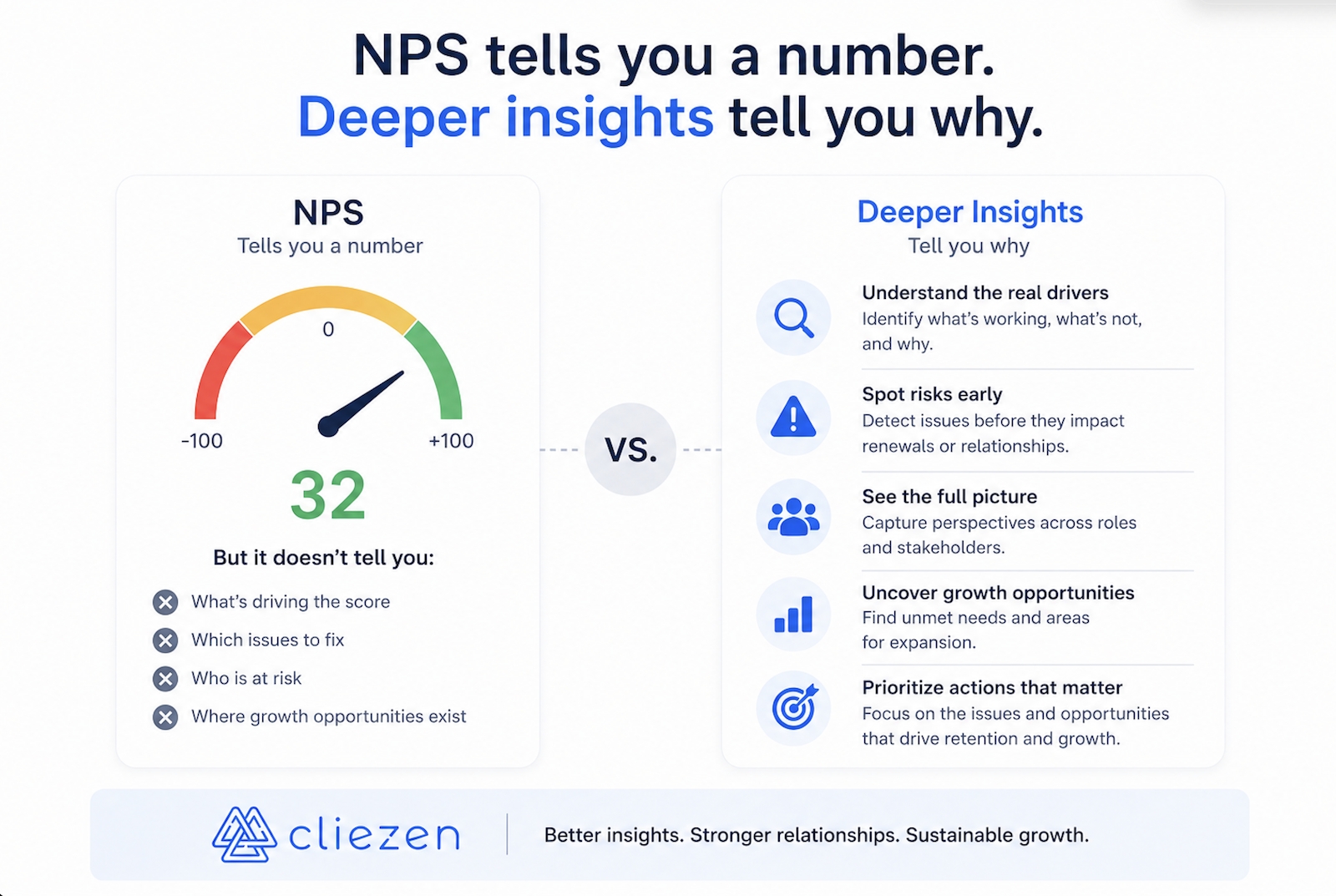
The result is a score that tells you whether someone is broadly positive or negative, but not why.
Without understanding the underlying causes of satisfaction or dissatisfaction, companies often find themselves reacting to symptoms rather than solving the actual problems affecting customer retention and growth.
NPS is a Lagging Indicator
One of the biggest limitations of NPS is that it measures sentiment after experiences have already occurred.
By the time a customer reports dissatisfaction through an NPS survey, the issues causing frustration may have existed for months.
In many B2B companies, especially those with annual contracts or long renewal cycles, customers can slowly disengage without showing obvious warning signs. Communication becomes less frequent. Strategic discussions disappear. Competitors enter conversations.
The relationship gradually deteriorates.
When renewal discussions finally arrive, leadership teams are often surprised to learn that a customer has already decided to leave.
NPS frequently identifies problems after the damage has already been done.
Low Response Rates Create Blind Spots
Most B2B organizations struggle to achieve meaningful response rates with traditional NPS programs.
Industry benchmarks often show response rates ranging between 3% and 15%, depending on the audience and survey approach.
This creates a significant challenge.
If only a small percentage of customers respond, how representative is the feedback? Are the responses coming from decision-makers? Are they coming from operational contacts? Are critical stakeholders missing entirely?
Many companies end up making strategic decisions based on feedback from a small subset of their customer base.
The larger the account and the more stakeholders involved, the greater this problem becomes.
NPS Doesn't Explain Revenue Risk
A score alone does not reveal business impact.
Two customers may both provide a score of 7.
One account may represent €5,000 in annual revenue. Another may represent €500,000.
One may be preparing to expand the relationship. Another may be actively evaluating competitors.
Traditional NPS systems treat these responses similarly.
B2B growth requires context.
Companies need to understand which relationships are most valuable, which expectations are not being met, and where dissatisfaction is likely to create financial consequences.
Without that context, prioritization becomes difficult.
Growth Opportunities Remain Hidden
Customer experience is not only about reducing churn.
It is also about identifying opportunities for expansion, cross-selling, upselling, and stronger strategic partnerships.
NPS was never designed to uncover these opportunities.
A promoter may still have unmet needs. A satisfied client may be actively looking for additional services. A key stakeholder may have emerging requirements that could create significant growth opportunities.
Because NPS focuses on recommendation likelihood rather than relationship quality, these signals often remain invisible.
Different Stakeholders Have Different Experiences
One of the biggest challenges in B2B customer experience measurement is that multiple stakeholders influence the success of a customer relationship.
The CFO may care about value realization.
The procurement team may focus on commercial terms.
Operational users may care about service quality.
Executive sponsors may focus on strategic outcomes.
Asking all of these stakeholders the same question ignores the reality that each experiences the relationship differently.
Meaningful customer insight requires understanding these perspectives individually rather than averaging them into a single score.
Why Modern B2B Companies Are Moving Beyond NPS
Leading B2B organizations are increasingly adopting approaches that focus on understanding the drivers behind customer sentiment rather than simply measuring it.
Instead of asking a single recommendation question, they seek to understand:
- Which aspects of the relationship are creating value
- Where expectation gaps exist
- Which customers are showing early signs of risk
- What factors are influencing retention and expansion
- Which actions will have the greatest impact on relationship quality
This provides teams with actionable intelligence rather than a number to monitor.
The Future of B2B Customer Experience Measurement
NPS is unlikely to disappear entirely. It remains a useful directional metric and can provide a broad indication of customer sentiment in B2C and retail sectors.
The challenge arises when companies mistake the score for the insight.
Growth is driven by understanding customers at a deeper level. It comes from identifying expectation gaps before they become problems, uncovering risks before customers leave, and discovering opportunities before competitors do.
For B2B companies focused on retention, expansion, and long-term customer value, the future lies not in measuring customer loyalty with a single number but in understanding the relationship factors that drive it.
Organizations that can identify these signals early gain a significant competitive advantage. Those that continue relying solely on NPS often find themselves reacting to problems after growth opportunities have already been lost.
Looking Beyond NPS
Modern B2B customer experience management requires more than static surveys, dissappointing response rates and high-level scores.
It requires continuous visibility into relationship health, stakeholder expectations, and the underlying drivers of customer satisfaction.
Understanding why customers feel the way they do is far more valuable than knowing how likely they are to recommend you.
The companies that recognize this distinction are often the ones that retain customers longer, uncover more expansion opportunities, and build stronger relationships that drive sustainable growth.


