Why NPS in B2B Creates Blind Spots Instead of Insights
Why NPS in B2B Creates Blind Spots Instead of Insights
A Practical Look at What B2B Customer Experience Teams Really Need
For years, many B2B companies have treated NPS as their primary Voice of Customer signal. It is familiar, easy to report, and comfortable to explain in a board meeting. But walk into enough renewal calls, churn reviews, or quarterly business updates, and a different pattern shows up.
Teams keep getting surprised by churn that was visible to the client for months.
This is not a mystery. It is a measurement problem disguised as a customer problem.
Below is a sober look at why NPS in B2B keeps companies blind and what modern B2B Customer Experience teams are doing instead.
The First Problem: B2B CX Tools Cannot Rely on Single-Digit Response Rates
When someone sets up an NPS survey, the hope is simple: send one question, get reliable insight.
That promise breaks instantly in a B2B environment.
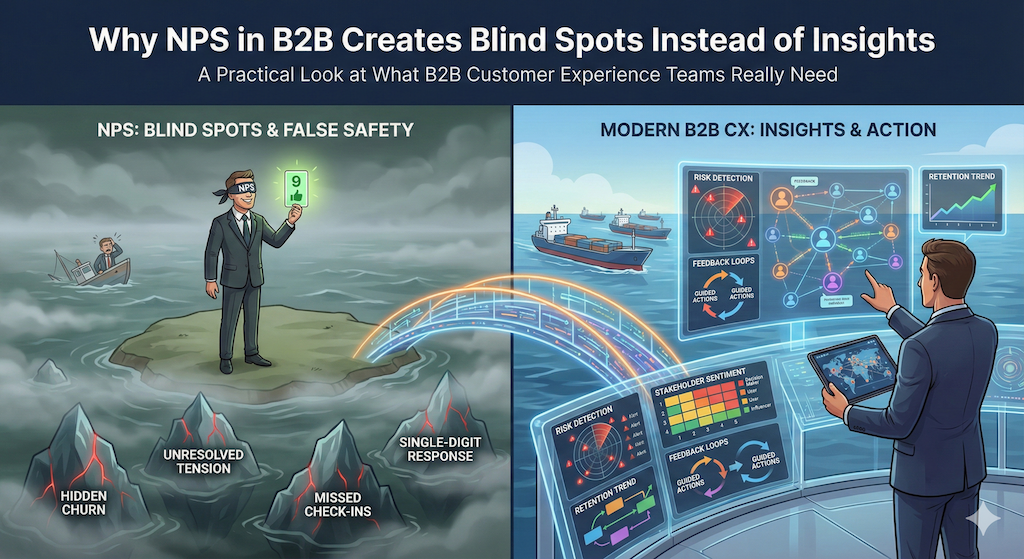
Only a tiny fraction answer. Often the friendliest voices. Rarely the decision maker who feels the real pressure. The most frustrated clients simply delete the survey. And yet leadership teams still build a story about “healthy customer satisfaction” on that thin set of responses.
It is not a feedback program. It is wishful thinking dressed as data.
High-value B2B relationships demand a stronger approach: role-specific insights, experience gap detection, and signals from every stakeholder, not just the ones who had time to click a number.
The Second Problem: NPS Creates False Momentum In Churn Prevention
Companies read the annual or monthly NPS trend and assume they are tracking progress. They are not. They are tracking who clicked a number.
I have seen NPS go up while a major account was already evaluating a competitor.
I have seen teams celebrate a score that came from three respondents.
I have seen dashboards glow green while the account manager quietly worries.
This is how churn sneaks up: not because there was no signal, but because the tool was never built for complex B2B relationships in the first place.
Real churn prevention requires more than a score. It requires a system that surfaces friction, expectation gaps, declining trust, and early warning signs long before renewal conversations begin.

The Third Problem: NPS Pretends to Be Listening But B2B Client Experience Requires Real Feedback Loops
This is the part that stings. NPS gives companies the illusion that they are listening.
You send a one-question survey.
They send a number.
Maybe a short comment.
Nothing in the relationship changes.
Next quarter, you ask again.
It is not listening. It is extraction. And clients feel it.
When you interrupt a client in the middle of their day, two things matter:
- Ask about something you are ready to improve.
- Close the loop fast and show the response mattered.
B2B clients are remarkably transparent when they know their input becomes action. They are equally blunt when they feel their time is being wasted on a one-size-fits-all question.
The Consequence: NPS Gives Leaders a False Sense of Safety
Executives see the score and assume the risk is low.
Meanwhile, the real story hides in the places NPS never touches:
- email threads
- missed check-ins
- project drift
- unresolved tension
- early signs of frustration across different roles
When a CX leader presents a single NPS score as “customer voice” in B2B, everyone walks away with the wrong picture. Not because they are careless, but because the tool was not designed for the job.
What Modern B2B CX Systems Must Deliver
A Practical Framework for Real Client Experience Management
The future of B2B Customer Experience is not a number. It is a system that does three things relentlessly:
1.
Find Risk Early
Not at renewal. Not during escalation.
A true Client Experience Platform surfaces friction as it appears across roles, touchpoints, and expectations. That includes the silent dissatisfaction NPS never captures.
2.
Explain Why It Is There
Without context, feedback is just noise.
Modern B2B CX systems map expectations vs. experience, highlight gaps, and trace the real drivers of churn. This is where data becomes usable.
3.
Help Teams Fix It Fast
Insight without action creates apathy.
A functioning CX system must turn feedback into guided actions, workflows, and real-time follow-ups. Close the loop quickly. Show clients the impact. Build trust.
This is how client retention actually improves: not through dashboards, but through better conversations driven by better signals.

The Shift From NPS to Dynamic B2B CX Systems
NPS is popular because it is simple. But simplicity without accuracy becomes a comfort blanket.
B2B companies now need something else entirely:
- higher response rates
- deeper insights
- multi-stakeholder visibility
- real-time risk detection
- automated feedback loops
- practical actions that reduce churn
This is the standard modern B2B organizations are moving toward. And it is the standard Cliezen is built for.
Final Word
When the stakes are high and the relationships are complex, one question cannot tell the story.
B2B feedback should not be a score. It should be a system that protects the relationship.
If your feedback tool cannot find risk, explain it, and help you act on it, then it is not a CX system.
It is a false sense of comfort in a market where companies cannot afford surprises.